
PCOD, Adolescent & Menopause Care
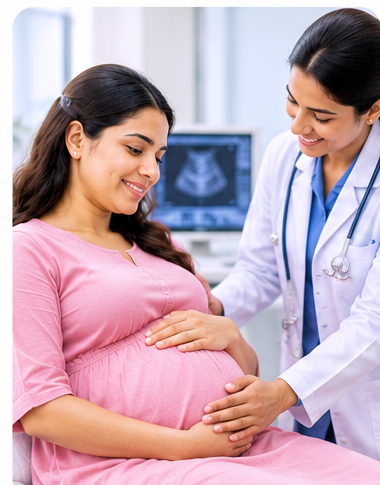
Care for irregular periods, PCOD, teenage concerns and the changes of menopause, at every stage of life.
Learn more
Difficulty conceiving is common, and in most couples a cause can be found. It may lie with the woman, the man, both partners, or sometimes neither. A proper evaluation of both partners is the first step, because treatment works best when it is aimed at the actual cause.
Dr. Swetha has completed a Fellowship in Infertility and an Advanced Diploma in Assisted Reproductive Technology. She offers the fertility work-up, follicular monitoring, ovulation induction and IUI, and laparoscopy or hysteroscopy where they are needed.
History, examination, hormone tests and scans for the woman, and a semen analysis for the man, to find out why conception is delayed.
A series of scans in one cycle to watch the egg grow and to time ovulation.
Medicines that help the ovaries release an egg, used with scan monitoring.
Prepared sperm is placed inside the womb around the time of ovulation. It is a short procedure done in the clinic.
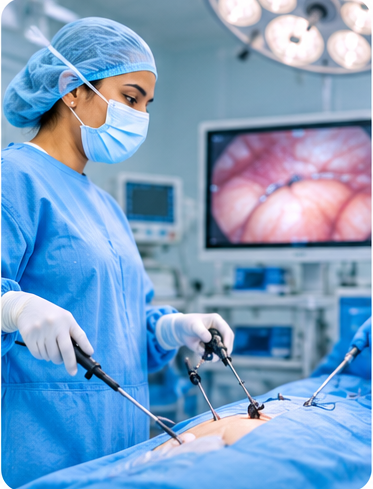
Keyhole procedures to check the tubes and womb, and to treat cysts, endometriosis, polyps or to carry out ovarian drilling in selected women with PCOD.
Here is how your care usually goes, step by step.
Both partners are seen together and earlier reports are reviewed.
Only the tests that are needed are advised, and each is explained.
A plan is chosen with you, starting with the simplest option that is likely to work.
Each cycle is monitored, and the plan is reviewed if pregnancy does not happen.
Both partners are evaluated, not just the woman.
Simple treatments are tried before complex ones where appropriate.
Scan monitoring times ovulation and treatment accurately.
Time is given to the emotional strain that fertility treatment brings.
After a year of trying, or after six months if the woman is over 35. Come sooner if periods are irregular or there is a known problem.
Not necessarily. Many couples conceive with simpler treatment such as ovulation induction or IUI. If IVF is the right next step, you will be told and guided.
Most women describe it as mildly uncomfortable, like a Pap test. It takes a few minutes and you can go home soon after.
Yes. A semen analysis is a simple test and an essential part of the evaluation.
Care for irregular periods, PCOD, teenage concerns and the changes of menopause, at every stage of life.
Learn moreKeyhole surgery for fibroids, ovarian cysts, endometriosis and hysterectomy, with smaller cuts and a quicker return to routine.
Learn moreClose monitoring and a clear plan for pregnancies that need extra attention — recurrent miscarriage, preterm labour, ectopic pregnancy and more.
Learn more