
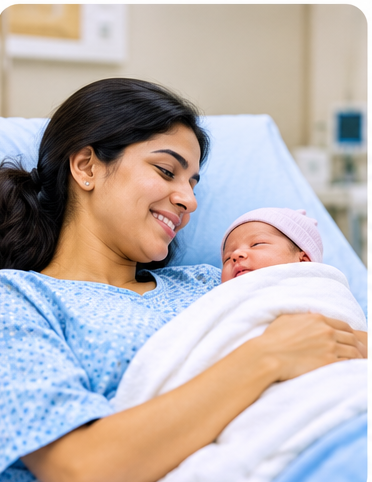
Normal, Painless & Caesarean Delivery
Support for the birth that is safest for you and your baby — normal vaginal birth, painless delivery, caesarean section and VBAC.
Learn more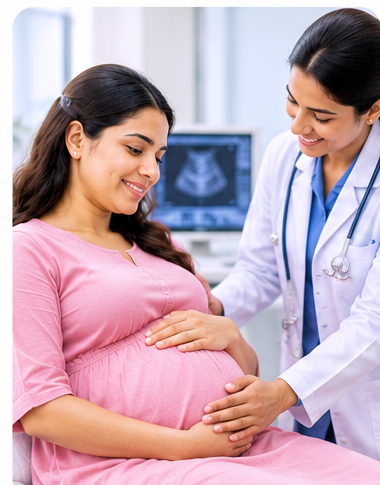
A pregnancy is called high-risk when the mother, the baby or both need closer watching than usual. Common reasons include high blood pressure, diabetes, thyroid problems, twins, a previous caesarean, earlier pregnancy losses, a low-lying placenta or the mother's age. High-risk does not mean something will go wrong. It means the pregnancy is followed more closely so that problems are found early.
Dr. Swetha Sree Ravi is a high-risk obstetrical consultant who has managed high-risk vaginal and caesarean deliveries in both government and private hospitals. Your visits, scans and tests are planned around your particular risk, and you are told clearly which warning signs need a call or a hospital visit.
More frequent antenatal visits, blood pressure and sugar monitoring, growth scans and timely tests, with the timing and place of delivery planned in advance.
A structured search for treatable causes after repeated pregnancy loss, followed by a plan and close support in the next pregnancy.
Assessment when labour threatens to start early, with treatment aimed at giving the baby more time and preparing for a safe birth if delivery cannot be delayed.
A stitch placed around a weak or short cervix to help it stay closed. It is advised only for women in whom it is likely to help.
Early diagnosis of a pregnancy growing outside the womb, and treatment with medicine or surgery depending on your condition.
Here is how your care usually goes, step by step.
A detailed history, examination and review of earlier reports to understand your individual risk.
A schedule of visits, scans and tests, with any medicines you need and the reasons for them.
Regular checks on you and the baby, and quick review if anything changes.
The timing, place and method of birth are discussed with you well before your due date.
Closer monitoring picks up changes while there is time to act.
You know what each test is for and what happens next.
The same consultant follows your pregnancy from start to finish.
Time to ask questions, especially after a previous loss.
No. Many women with high-risk pregnancies have a normal vaginal birth. The method of delivery depends on your condition and the baby's at that time, and it is discussed with you beforehand.
Usually more often than in a routine pregnancy. The exact schedule depends on your condition and how the pregnancy is progressing.
Many women do go on to have a healthy baby after repeated losses. An evaluation looks for causes that can be treated, and your next pregnancy is followed closely from the start.
As soon as you know you are pregnant, or ideally before you conceive if you already have a medical condition or a previous complicated pregnancy.
Support for the birth that is safest for you and your baby — normal vaginal birth, painless delivery, caesarean section and VBAC.
Learn moreA step-by-step fertility work-up for couples, with follicular study, ovulation induction and IUI.
Learn moreCare for irregular periods, PCOD, teenage concerns and the changes of menopause, at every stage of life.
Learn more