
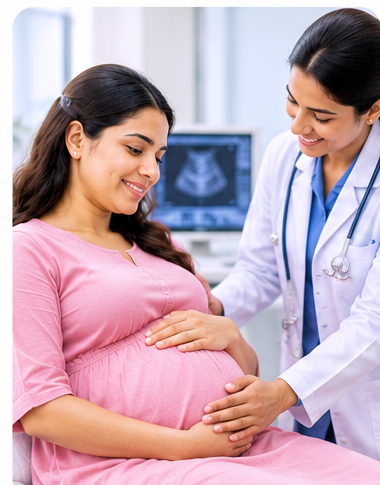
High-Risk Pregnancy Care
Close monitoring and a clear plan for pregnancies that need extra attention — recurrent miscarriage, preterm labour, ectopic pregnancy and more.
Learn more
Every birth is different. Most women can have a normal vaginal birth, some choose pain relief in labour, and some need a caesarean section for their own safety or their baby's. The right choice is the one that fits your health, your pregnancy and your wishes.
Dr. Swetha has conducted normal, instrumental and high-risk vaginal deliveries as well as routine and high-risk caesarean sections. Your options are discussed during your antenatal visits so that you arrive in labour knowing what to expect.
Labour is monitored closely and allowed to progress naturally, with help given only when it is needed.
Pain relief in labour, most often an epidural given by an anaesthetist, so that you stay awake and can take part in the birth with much less pain.
The baby is delivered through a cut in the lower abdomen. It may be planned in advance or done as an emergency during labour.
Vaginal birth after a previous caesarean. It is offered to suitable women after a careful review of the earlier operation and the current pregnancy.
Assistance with a vacuum cup or forceps in the final stage of labour when the baby needs to be born quickly.
Here is how your care usually goes, step by step.
Your options are discussed in the last months of pregnancy, including pain relief.
Your progress and the baby's heartbeat are monitored from the time you are admitted.
Normal, assisted or caesarean birth, depending on what is safest at the time.
Help with breastfeeding, pain relief, wound care if needed and advice before you go home.
You understand the options and the reasons for any recommendation.
Painless delivery can be arranged for women who want it.
Mother and baby are monitored throughout labour.
Support with feeding and recovery in the first days.
Epidural pain relief is widely used in labour. The anaesthetist will explain its benefits and possible side effects before you decide.
Often yes, but not always. It depends on why the earlier caesarean was done, the type of cut on the womb and how this pregnancy is going.
It is usually shorter after a vaginal birth than after a caesarean. Your stay depends on how you and your baby are doing.
You can discuss your reasons with Dr. Swetha. She will explain the benefits and risks of each method so that you can decide together.
Close monitoring and a clear plan for pregnancies that need extra attention — recurrent miscarriage, preterm labour, ectopic pregnancy and more.
Learn morePrivate, practical advice on spacing or completing your family — IUCD, tubectomy and other options.
Learn moreA step-by-step fertility work-up for couples, with follicular study, ovulation induction and IUI.
Learn more